Physical Address
304 North Cardinal St.
Dorchester Center, MA 02124
Physical Address
304 North Cardinal St.
Dorchester Center, MA 02124

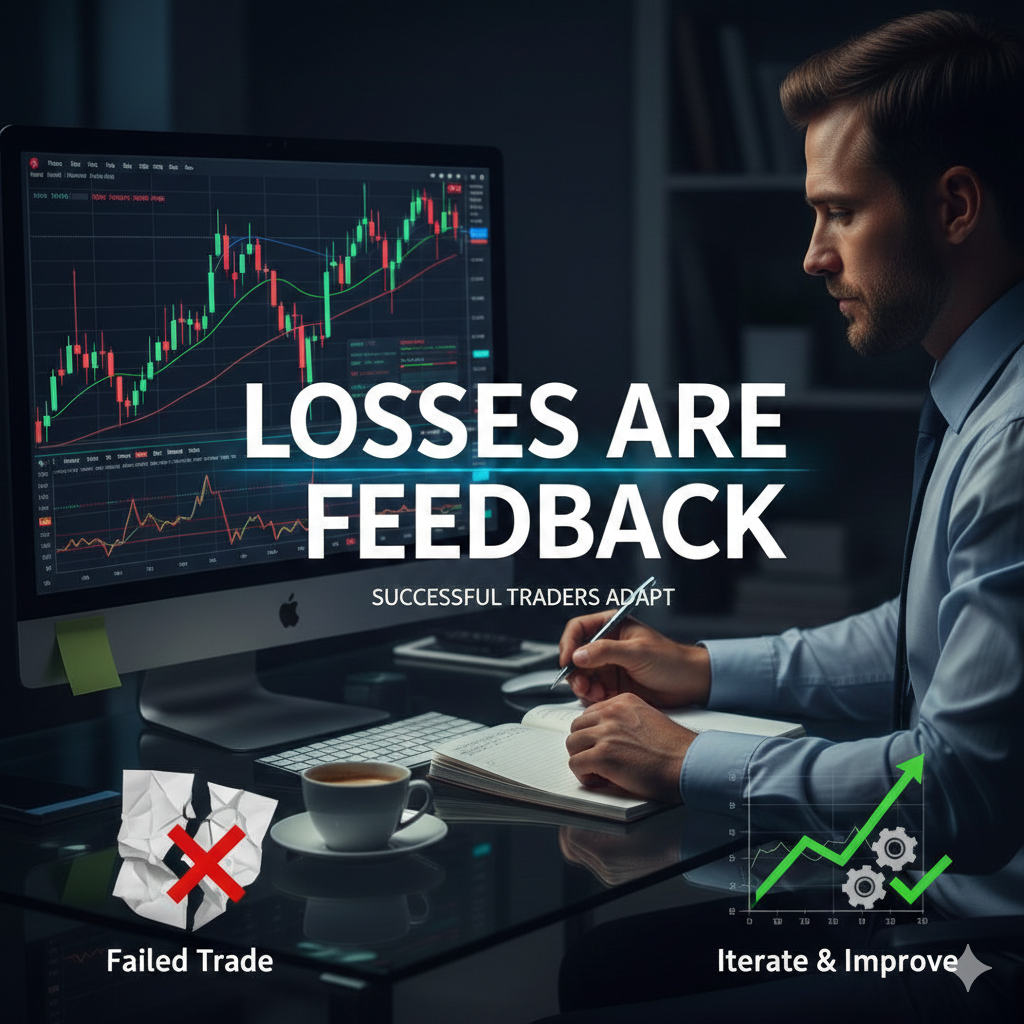
This is how successful forex traders treat losses as feedback, how they survive volatile markets, and how beginners can adopt the same mindset for long-term success.
Most forex traders fear losses. Successful traders study them.
After years of trading in volatile markets, I learned that losses are not punishment — they are information. How you interpret losing trades separates those who survive long-term from those who blow accounts.
This article explains:
Every trader loses. Even profitable traders take losing trades.
The mistake is reacting emotionally:
Beginners often repeat these mistakes, as explained in Top 5 Mistakes Beginner Forex Traders Make and How to Avoid Them.
Professional traders review losses calmly using TradingView replay tools to analyze market structure and entries.
High-impact news doesn’t create bad traders — it exposes them.
Major economic releases can magnify:
Successful traders track releases on the , avoiding unnecessary exposure.
Real volatility lessons are demonstrated in How GBPUSD Reacts to US Tariff News: 2026 Volatility Trading Guide.
Professional traders don’t ask:
❌ “Why did I lose money?”
They ask:
✅ “What can I learn from this loss?”
They focus on:
Keeping a trading journal and tracking metrics on Myfxbook is essential.
This mindset shift was also key in What 5 Years of Forex Trading Taught Me.
Many traders misinterpret losses because they lack market understanding.
Resources like BabyPips and Investopedia help traders learn:
For foundational knowledge, see What Is Forex Trading? A Beginner’s Guide to the Foreign Exchange Market.

Traders with small accounts feel losses more acutely, often leading to:
Strict risk management and feedback-focused analysis are essential, as discussed in Can You Grow a Small Forex Account of Just $10?.
Prop firms enforce strict rules because they understand psychology.
Treating losses as feedback is critical when:
Relevant guides:
Most traders don’t fail because of a bad strategy — they fail because they:
This explains why many traders struggle to earn long-term, as detailed in Can You Really Make Money Trading Forex?.
Losses are part of the learning process in forex trading.
Treat them as punishment → you quit.
Treat them as feedback → you improve.
This mindset shift separates long-term traders from those who disappear after months of losses.
Yes. Every successful trader loses regularly. The difference is they expect losses, control them, and learn from them instead of fighting them.
Process over outcome. Successful traders focus on execution quality, risk control, and consistency—not on single trade results.
No. Many profitable traders win only 40–55% of the time. They focus on risk-to-reward, not win percentage.
They see losing streaks as statistical phases, not personal failure. They reduce risk, review data, and wait for conditions to normalize.
Only after data-backed evidence. They never change strategies emotionally or after just a few losing trades.
Typically 0.25%–2% per trade. Capital preservation always comes before profits.
No. Revenge trading is viewed as account sabotage, not trading.
They rely on rules, checklists, and automation, not willpower. Emotions are managed by systems, not motivation.
A major one. Successful traders journal to:
No. They trade only when conditions meet their edge. Many professionals trade just a few times per week.
They:
No. They react, not predict. The market decides—traders manage risk.
Discipline is more important. A simple strategy executed well beats a complex strategy executed poorly.
Some do, some don’t. Success depends on how well the tool is understood, not which tool is used.
Most took 2–5 years of consistent learning, losing, refining, and psychological development.
Rarely—and when they do, they stop trading and review immediately.
They step away, journal, analyze execution, and return only when emotionally neutral.
No. Risk stays constant. Consistency beats aggression.
Not by profit alone, but by:
Because trading is probabilistic, not deterministic. Uncertainty is part of the edge.
Some do, some avoid it completely. What matters is knowing your strategy’s environment.
They acknowledge institutional activity but focus on what they can control, not conspiracy thinking.
Through position sizing. Fear disappears when risk is controlled.
No. They may learn from others, but execution is always independent.
Moving from:
“I must win this trade” and “I must execute this trade correctly”
Because they treat losses as information, not punishment.
Skill. Built through repetition, review, and discipline.
Only pairs they understand deeply. Familiarity beats diversification.
They lower risk, simplify execution, and focus on process—not profits.
They try to avoid losses instead of managing them.